

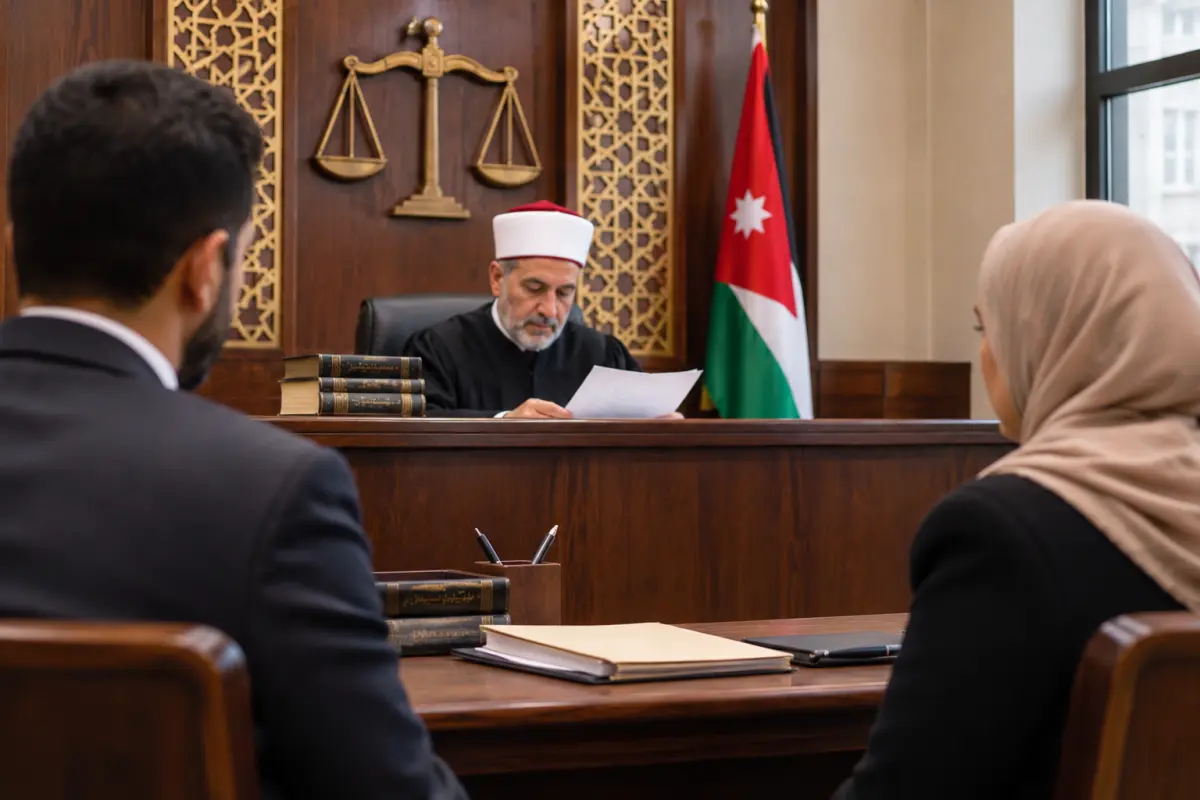

Judicial Separation and Marriage Dissolution Under Jordanian Law
Judicial Separation in Jordan: Grounds, Legal Procedures and Spousal Rights
Judicial separation under Jordanian law provides legal remedies when a marriage can no longer continue and the husband has not voluntarily pronounced divorce. Jordanian Personal Status Law No. 15 of 2019 recognizes several grounds for judicial dissolution, including marital discord, harm, failure to provide maintenance, prolonged absence, imprisonment, and certain medical conditions.
For individuals searching for the best Sharia lawyer in Jordan, understanding the differences between these legal remedies is essential because each procedure has its own conditions and financial consequences.
At Al-Jamal Law Office, attorney Enas Al-Jamal provides legal consultation and representation in family and personal status matters before the competent Jordanian courts.
This article explains the principal provisions addressed in Articles 114–144 of the Jordanian Personal Status Law.
1. What Is Judicial Separation?
Judicial separation is the dissolution of a marriage through a court judgment based on legally recognized grounds.
Unlike consensual divorce, judicial separation may be available even when one spouse refuses to end the marriage voluntarily.
However, not all judicial separation cases have the same legal consequences.
Some result in annulment of the marriage contract, while others result in an irrevocable or revocable divorce.
The appropriate legal action depends on the facts, evidence, and specific statutory requirements.
2. Judicial Dissolution Through Redemption (Iftida)
Article 114 provides a legal mechanism allowing a wife to request dissolution through redemption, sometimes referred to as judicial Khula.
This procedure differs from consensual Khula because it is pursued through the court even when the husband refuses to agree to divorce.
Before Consummation
Where a wife requests separation before consummation, she must deposit the dowry she received, the gifts she received, and the marriage-related expenses incurred by the husband as required by the relevant provisions.
If the husband refuses to divorce her, the court attempts reconciliation.
If reconciliation fails, two arbitrators continue reconciliation efforts for up to 30 days.
If those efforts are unsuccessful, the court may order annulment of the marriage contract.
Disagreements about the value of gifts or marriage expenses are assessed by the arbitrators.
After Consummation or Valid Marital Seclusion
Where the marriage has been consummated or valid marital seclusion has occurred, the wife may seek dissolution by expressly declaring that she cannot continue marital life with her husband and fears she cannot fulfill the obligations of marriage.
She must return the dowry received and waive her marital financial rights in accordance with Article 114.
The court attempts reconciliation and, if necessary, appoints arbitrators for a period not exceeding 30 days.
If reconciliation remains unsuccessful, the court orders annulment.
Important: Judicial redemption does not extinguish children's independent rights to maintenance or custody.
3. Judicial Separation Due to Marital Discord and Harm
Either spouse may request judicial separation for marital discord and harm where the other spouse's conduct makes continued married life impossible.
The harm may be physical or nonphysical.
Physical and Verbal Harm
Examples include physical abuse, harmful treatment, and verbal mistreatment.
Moral and Psychological Harm
The law also recognizes harmful conduct that causes moral injury, including persistent failure to fulfill marital obligations.
How Does the Court Handle the Case?
The court first attempts reconciliation.
If the dispute remains unresolved, the applicable procedures include allowing time for reconciliation and appointing two arbitrators to examine the causes of the conflict.
The arbitrators assess the circumstances, attempt to reconcile the spouses, and consider the degree of responsibility attributable to each party.
The resulting judicial separation is an irrevocable divorce.
How Are Financial Rights Determined?
Financial consequences depend on the arbitrators' findings.
Where the husband is entirely responsible for the harm, the wife may retain her applicable marital financial rights, including unpaid dowry and waiting-period maintenance.
Where both spouses contributed to the conflict, financial compensation may be allocated in proportion to each party's responsibility.
If the circumstances cannot be clearly established, the arbitrators may determine compensation within the limits specified by law.
Evidence is therefore especially important in these proceedings.
4. Judicial Divorce for Failure to Provide Maintenance
A wife may seek judicial divorce where her husband refuses or is unable to pay maintenance.
The court's response depends on the husband's circumstances.
Husband Who Can Pay but Refuses
If the husband acknowledges his financial ability yet refuses to pay, or claims inability without proving it, the court may order divorce immediately.
Husband Who Proves Financial Inability
If the husband establishes that he cannot afford maintenance, the court may allow between one and three months for him to pay the maintenance awarded from the date the separation claim was filed and provide a guarantor for future payments.
If he fails to meet these requirements, the court may order divorce.
Can the Husband Reconcile After Divorce for Nonpayment?
Where the divorce occurs after consummation and is not the third divorce, it is generally revocable.
However, reconciliation requires the husband to pay three months of accumulated maintenance and provide a guarantor for future maintenance.
Without these conditions, reconciliation is not valid under the relevant provisions.
5. Separation Due to Absence, Desertion or Imprisonment
Jordanian law provides remedies where the husband is absent or has abandoned the marital relationship.
Prolonged Absence
A wife may request annulment if her husband has been absent for one year or longer and she suffers harm from the absence, even where he has sufficient funds to support her.
Marital Desertion
Where the husband deserts his wife and refuses marital relations while living in the marital home for at least one year, she may seek annulment.
The applicable procedure includes granting the husband a period of at least one month to remedy the situation.
Imprisonment
A wife may request annulment where the husband has received a final sentence of imprisonment for three years or longer and at least one year of imprisonment has elapsed.
These remedies depend on the statutory requirements and the evidence presented to the court.
6. Dissolution Due to Defects, Illness or Infertility
The law also recognizes certain medical and physical grounds for judicial dissolution.
Conditions Preventing Consummation
A wife may seek dissolution where her husband has a condition that prevents consummation.
If the condition is incurable, the court may order dissolution immediately.
If treatment is possible, the husband may be granted one year.
The wife's prior knowledge or subsequent acceptance of the condition can affect her right to request dissolution, subject to the exceptions provided by law.
Serious Medical Conditions
Certain serious illnesses that make marital life harmful may provide grounds for dissolution.
The court may rely on medical experts to determine whether recovery is likely.
If recovery is considered unlikely, dissolution may be ordered immediately. Otherwise, a period of up to one year may be allowed.
Infertility
Under the conditions addressed in the source material, a wife who is capable of having children, has no children, and is under 50 may seek annulment because of the husband's medically established infertility after five years have passed since consummation.
The law requires the relevant medical evidence and supporting testimony.
7. Other Grounds for Judicial Dissolution
Additional circumstances addressed by the law include:
Failure to pay the immediate dowry: Before consummation, a wife may request annulment where the husband cannot pay the immediate dowry, subject to the applicable one-month period.
Missing husband: The law distinguishes between disappearance under ordinary safe conditions and circumstances in which death is likely.
The source identifies a four-year period in ordinary safe circumstances and a period of at least one year in circumstances involving a serious likelihood of death.
The specific legal requirements must be assessed before bringing a claim.
8. Judicial Separation vs. Consensual Divorce
The legal distinction matters because the consequences differ.
| Legal procedure | General legal outcome |
|---|---|
| Judicial redemption (Iftida) | Annulment |
| Marital discord and harm | Irrevocable divorce |
| Failure to provide maintenance | Generally revocable after consummation |
| Prolonged absence or desertion | Annulment |
| Imprisonment | Annulment |
| Qualifying defects or medical conditions | Annulment |
The precise legal result depends on the relevant statutory provisions and individual circumstances.
9. Frequently Asked Questions
Can a wife seek judicial separation without proving abuse?
Yes. Judicial redemption under Article 114 provides a procedure that does not require proof of wrongdoing by the husband, provided its specific conditions are met.
How long does reconciliation take in judicial redemption cases?
The source provides for reconciliation efforts through two arbitrators for a period not exceeding 30 days after the court's initial attempt at reconciliation.
Can a wife request separation if her husband refuses to provide maintenance?
Yes. The court may order divorce under the applicable provisions, with different procedures depending on whether the husband can afford payment.
Does judicial redemption cancel child maintenance?
No. The independent legal rights of children, including maintenance and custody, are not extinguished by judicial redemption.
Can infertility provide grounds for judicial dissolution?
Yes, but only where the specific statutory requirements concerning the wife's circumstances, the period of marriage, and medical proof are satisfied.
10. Consult a Judicial Separation Lawyer in Jordan
Judicial separation cases require careful consideration of the legal grounds, financial consequences, medical or other evidence, and procedural requirements.
If you are comparing options for an experienced family lawyer in Amman or searching for the best Sharia lawyer in Jordan, consider the lawyer's experience with judicial separation and personal status proceedings.
Al-Jamal Law Office, led by attorney Enas Al-Jamal, provides legal consultation and representation in matters involving marital discord, judicial redemption, nonpayment of maintenance, and other recognized grounds for marital dissolution.
Contact Al-Jamal Law Office to discuss the procedures available in your circumstances.
Legal Disclaimer: This article is provided for general educational purposes based on Jordanian Personal Status Law No. 15 of 2019. It does not replace individualized legal advice.